Can a Dosing Strategy That Worked in Prostate Cancer Predict a Benefit in Melanoma?
Many cancer drugs work at first, and then the tumor grows back because some cells were resistant. Two questions follow. Is that resistance usually there before treatment starts? And if it is, can a smarter dosing plan delay the day the tumor takes over?
This project combines three published pieces of evidence into one model to test whether a result from one cancer type can predict what should happen in another. It collects no new patient or cell data. Every input is labeled as either published data or a stated assumption.
The three sources of evidence
Lineage tracing. DNA-barcoding studies of melanoma show that drug-resistant cells are usually already present before treatment, at roughly one in a thousand to one in ten thousand cells.
Cell lines. A published panel of melanoma cell lines treated with vemurafenib shows that resistant lines carry an identifiable cause of resistance, such as loss of PTEN or overexpression of COT, before the drug is applied.
A clinical trial. In an adaptive abiraterone trial for metastatic prostate cancer, pausing treatment once the tumor shrank and resuming when it regrew raised median time to progression from 14.3 to 33.5 months, using less than half the total drug.
The model
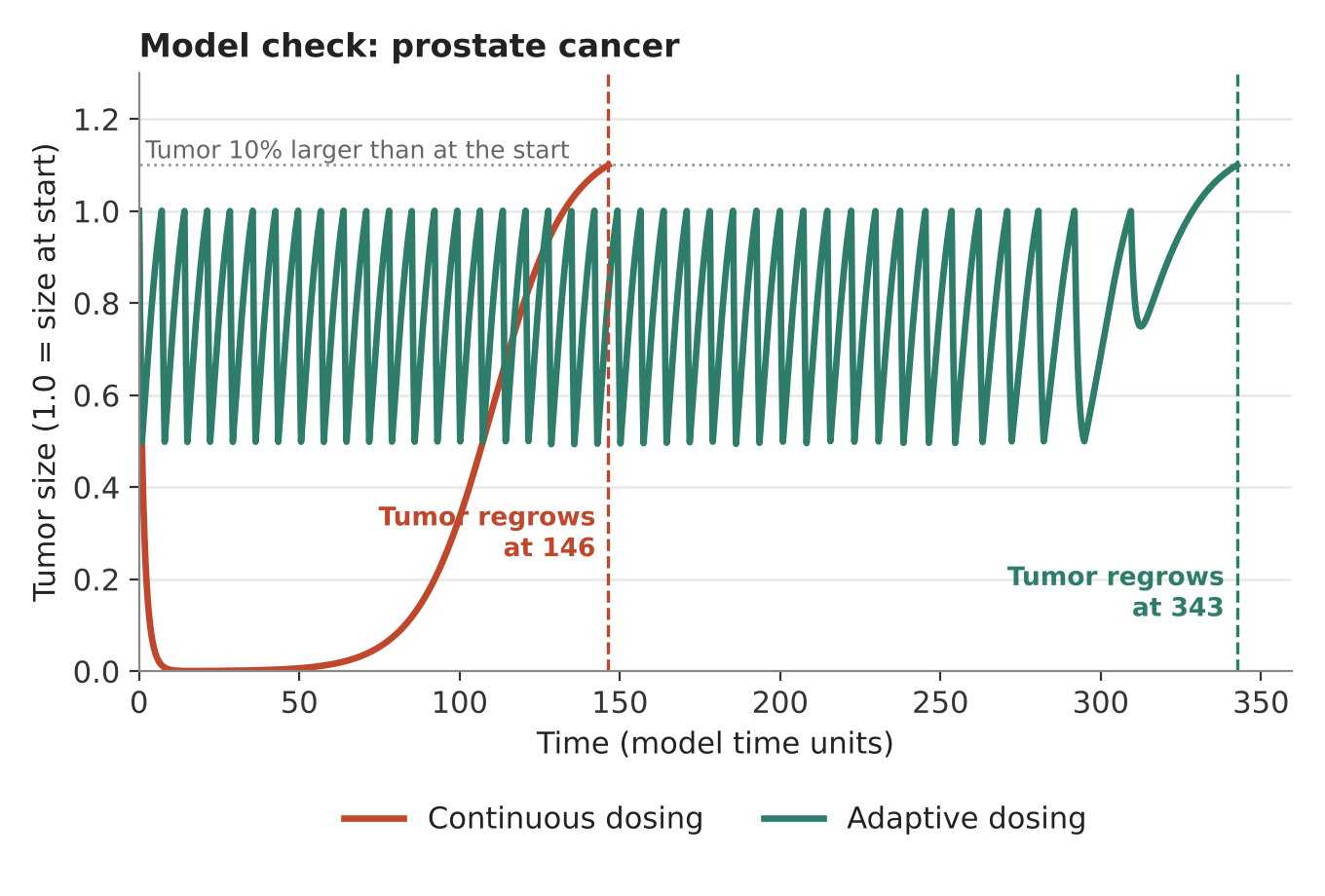
The tumor is two competing cell groups sharing limited space: drug-sensitive and drug-resistant. Resistant cells grow more slowly without the drug, which is the price of resistance. Continuous dosing keeps the drug on. Adaptive dosing pauses at half the starting tumor size and resumes at the full starting size, matching the real trial. The one uncertain number, the growth penalty for resistance, was tuned until the model reproduced the prostate trial's adaptive-to-continuous ratio of 2.34. That tuned value was then carried into melanoma unchanged, along with the real melanoma starting resistance frequency.
The prediction
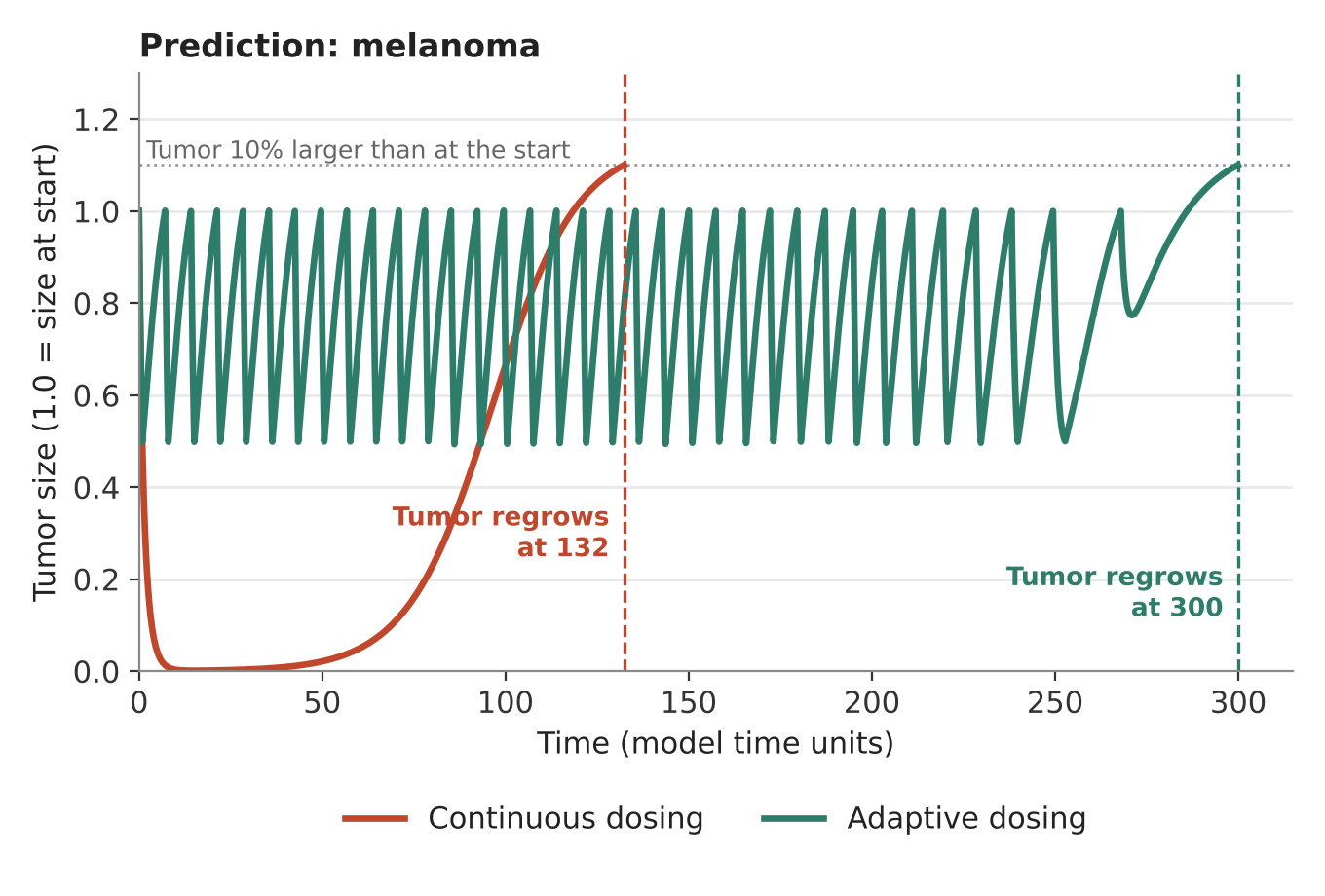
With melanoma inputs, the model predicts that adaptive vemurafenib dosing would delay tumor regrowth by about 2.2 times compared with continuous dosing (300 versus 132 model time units, a ratio of 2.27).
Does it depend on the starting resistance?
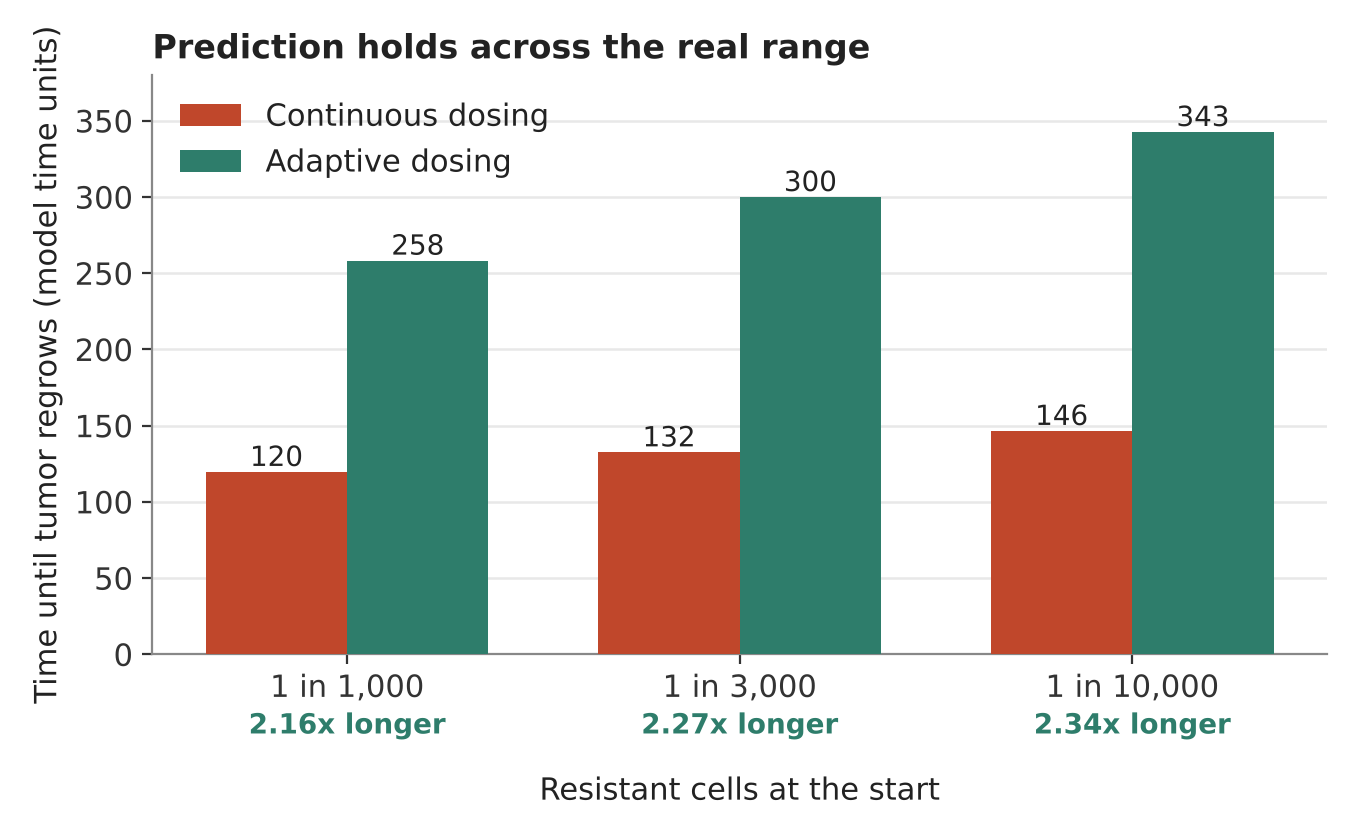
The published studies give a range rather than one number, so the model was rerun across that range. The benefit held throughout.
| Resistant cells at start | Continuous | Adaptive | Ratio |
|---|---|---|---|
| 1 in 1,000 (upper end) | 120 | 258 | 2.16 |
| 1 in 3,000 (middle) | 132 | 300 | 2.27 |
| 1 in 10,000 (lower end) | 146 | 343 | 2.34 |
What this does and doesn't show
The model matches the prostate result by construction, so that is a consistency check, not a finding. The new result is that the same tuned number, given real melanoma inputs, still predicts a large benefit in a different cancer type. This is a hypothesis worth testing, not proof that adaptive vemurafenib dosing would work in patients. Three model inputs (growth rate, kill rate, and crowding limit) were set to give a realistic timeline rather than measured, the prostate tuning rests on a single trial of a single drug, and the model treats tumors as just two cell groups.
Key references
- Zhang, Cunningham, Brown, and Gatenby. Integrating evolutionary dynamics into treatment of metastatic castration resistant prostate cancer. Nature Communications, 8, 1816, 2017 (four-year follow-up 2021).
- Emert et al. Rewind lineage tracing of drug-resistant melanoma cells.
- Goyal lab. FateMap twin-split clonal fate mapping in melanoma (bioRxiv preprint).
- CloneSweeper. Identification of pre-existing resistant lineages in a barcoded melanoma population (bioRxiv preprint).